

What is co-parenting counselling? a 2026 guide


Co-parenting counselling is a child-focused therapeutic intervention designed to help separated or divorced parents build a functional parenting partnership, with communication and conflict reduction at its core. Known formally as co-parenting therapy, it is not about repairing a romantic relationship. It is about creating a stable, predictable environment where your children can thrive regardless of what happened between you and your former partner. If you are searching for what is co-parenting counselling and whether it could help your family, this guide covers exactly how it works, what to expect, and where to find support in 2026.
What is co-parenting counselling and how does it work?
Co-parenting counselling is delivered through structured sessions led by a neutral therapist whose sole focus is the parenting relationship, not the personal history between you. Sessions are available in two primary formats: joint sessions where both parents attend together, and individual sessions for situations where conflict makes joint attendance unworkable.
The process typically follows a clear sequence:
Initial assessment. The therapist meets with each parent separately to understand the conflict patterns, communication breakdowns, and each parent’s goals for the children.
Goal setting. Both parents agree on specific, measurable targets such as reducing hostile exchanges at school pick-ups or aligning bedtime rules across both homes.
Structured communication practice. Sessions move parents from reactive, high-emotion interactions to calm, structured exchanges focused entirely on the children’s needs.
Rule harmonisation. The therapist helps both parents create consistent routines and boundaries across two households, which directly reduces children’s psychological distress.
Review and adjustment. Progress is monitored, and in court-mandated cases, the therapist may submit reports to confirm compliance with custody arrangements.
Online sessions are increasingly common and offer real flexibility for parents with demanding schedules or who live in different towns. Family courts frequently mandate co-parenting counselling in high-conflict custody disputes, with progress reports submitted to ensure the child’s best interests remain protected.
Pro Tip: Before your first session, write down three specific situations where communication with your co-parent broke down recently. Concrete examples help the therapist identify patterns quickly and make sessions far more productive from the outset.

What are the key benefits of co-parenting counselling?
The benefits of co-parenting counselling extend to both parents and, most critically, to the children caught between two households. Research consistently shows that stability and predictability are the primary therapeutic goals, and the outcomes reflect that.
Here is what parents and children typically gain:
Reduced conflict at handovers. Therapists teach specific techniques for keeping exchanges brief, neutral, and child-focused, removing the tension children absorb during these moments.
Improved shared decision-making. Parents learn to discuss schooling, medical care, and extracurricular activities without those conversations escalating into arguments about the past.
Consistent rules across homes. When bedtimes, screen time limits, and homework expectations align, children feel secure rather than confused or manipulated.
Lower psychological distress in children. Harmonising rules across homes directly reduces the anxiety and behavioural difficulties children display when their two worlds feel incompatible.
A shifted parental mindset. Effective co-parenting therapy moves you from asking “what is fair for me?” to asking “what does my child need right now?” That shift is the foundation of every lasting improvement.
Emotional regulation for parents. Individual sessions are particularly effective for managing your own triggers, so you stop reacting and start responding.
The Counselling Directory notes that therapists guide parents to adopt a professional partnership model, treating the co-parenting relationship like a business arrangement centred entirely on the child. That framing is counterintuitive for many parents, but it is one of the most effective reframes in co-parenting therapy.
How does co-parenting counselling differ from couples therapy?
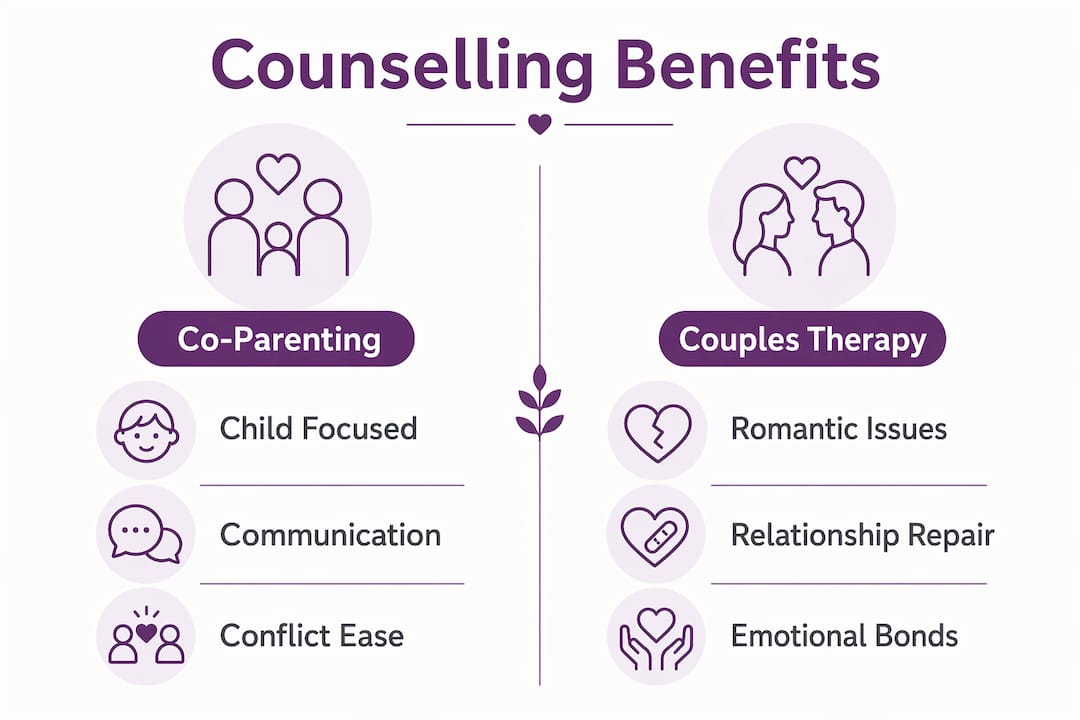
Many parents arrive confused about which type of support they actually need. The distinction matters because choosing the wrong format wastes time and can deepen resentment.
Co-parenting counselling focuses exclusively on the parenting partnership after separation. It never aims for romantic reconciliation. Couples therapy, by contrast, addresses the romantic relationship itself, exploring attachment patterns, intimacy, and relationship repair. Family therapy brings children and sometimes extended family members into the room to address broader relational dynamics.
The table below summarises the key differences clearly:
Therapy Type | Primary Focus | Who Attends | Goal |
Co-parenting counselling | Parenting partnership post-separation | Both parents (or one, individually) | Child stability and communication |
Couples therapy | Romantic relationship | Both partners | Relationship repair or closure |
Family therapy | Whole family system | Parents, children, sometimes extended family | Broader relational health |
Co-parenting therapy is the most structured of the three. Sessions are goal-driven and centred on the child’s best interests rather than the parents’ emotional history. If you and your former partner are separated and not seeking reconciliation, co-parenting counselling is the correct starting point. If you are still together but struggling with parenting disagreements, couples therapy is the more appropriate route.
The overlap with family therapy is worth noting. Some families transition from co-parenting sessions into family therapy once communication between parents stabilises, bringing the children in to process the separation together. These are complementary, not competing, approaches.
How do you access co-parenting support in 2026?
Finding the right co-parenting support depends on your circumstances, budget, and the level of conflict involved. The options available in 2026 are broader than most parents realise.
Private therapy practices. Many therapists specialise in post-separation parenting. Costs vary significantly, and some practices offer sliding-scale fees based on income.
Online therapy platforms. Services like those offered by Brightlifefamilycentre provide flexible scheduling that works for parents in different locations or with demanding work patterns.
Court-mandated programmes. In high-conflict cases, a judge may order co-parenting counselling as part of a custody arrangement. Compliance is monitored and reported back to the court.
Community and charity services. Organisations such as Coram Family Lives offer co-parenting courses after divorce at low or no cost, making support accessible regardless of financial situation.
Digital co-parenting tools. Apps like OurFamilyWizard are mandated in some jurisdictions to complement counselling by enforcing communication rules, tracking shared expenses, and documenting exchanges. Subscription costs run to approximately £120 per year.
Self-guided resources. Worksheets, online courses, and helplines provide additional support between sessions, particularly useful during high-stress periods like school transitions or holiday scheduling.
Pro Tip: Combine counselling sessions with a digital communication tool like OurFamilyWizard. The app creates a documented, neutral record of all parenting exchanges, which removes ambiguity, reduces conflict triggers, and provides evidence of compliance if your case returns to court.
If you are managing parental burnout alongside a difficult co-parenting situation, individual therapy is often the most practical first step. It allows you to build emotional resilience before entering joint sessions.
Key takeaways
Co-parenting counselling is the most direct route to reducing conflict and protecting your children’s emotional wellbeing after separation.
Point | Details |
Clear definition | Co-parenting counselling is child-focused therapy for separated parents, not couples therapy. |
Session formats | Both joint and individual sessions are available, including online options for flexibility. |
Core benefit | Harmonising rules and communication across two homes reduces children’s psychological distress. |
Key distinction | It differs from couples therapy by focusing solely on parenting, never on romantic reconciliation. |
Practical access | Options range from private therapists to free community courses and digital tools like OurFamilyWizard. |
What i have learned working with co-parenting families
The biggest misconception I encounter is that co-parenting counselling is about getting the other parent to change. Parents arrive hoping the therapist will validate their position and correct their former partner’s behaviour. That is not how it works, and understanding this early saves a great deal of frustration.
What the process actually asks of you is harder and more personal. It asks you to examine your own reactions, your own communication patterns, and your own triggers. The individual sessions that help parents manage emotional regulation are often the most transformative part of the entire process, precisely because they focus on what you can control.
I have also seen parents measure success incorrectly. They expect conflict to disappear entirely. The real measure is whether your children feel stable, loved, and free from the burden of your adult disagreements. A co-parenting relationship does not need to be warm or friendly. It needs to be functional and consistent. That is a far more achievable goal, and it is the one worth working towards.
The parents who make the most progress are those who commit to the process even when it feels one-sided. You cannot control whether your co-parent engages fully. You can control whether you show up, do the work, and give your children the stability they deserve.
— Bright
How Brightlifefamilycentre supports co-parenting parents
Brightlifefamilycentre offers tailored therapy for parents navigating separation, with a particular focus on communication, emotional regulation, and child wellbeing. Sessions are available online, making them accessible whether you are in the same city as your co-parent or not.

If joint sessions feel too difficult right now, individual therapy is a strong starting point. It builds the emotional foundation you need before entering a shared therapeutic space. For parents ready to work together, Brightlifefamilycentre’s online therapy services provide flexible, expert-guided co-parenting support designed around your schedule and your children’s needs. Reach out to Brightlifefamilycentre to book a first session and take the first concrete step towards a more stable family life.
FAQ
What is the difference between co-parenting counselling and mediation?
Co-parenting counselling is a therapeutic process focused on long-term communication and emotional patterns, while mediation is a legal process aimed at resolving specific disputes such as custody arrangements. Both can be used together, but they serve different purposes.
Can i attend co-parenting counselling without my former partner?
Individual co-parenting counselling is effective when joint sessions are not possible, helping you manage emotional triggers and communicate more calmly. You do not need your co-parent’s participation to benefit.
How long does co-parenting counselling typically last?
Session length varies depending on conflict level and goals, but most parents see meaningful progress within six to twelve sessions. Court-mandated programmes may specify a minimum number of sessions.
Is co-parenting counselling legally required?
Family courts may mandate co-parenting counselling in high-conflict custody cases, with progress reports submitted to the court. Outside of legal mandates, attendance is voluntary.
Does co-parenting counselling help children directly?
Co-parenting counselling works indirectly by improving the parental relationship your children experience. When parents communicate calmly and maintain consistent rules, children’s anxiety and behavioural difficulties reduce significantly.
Recommended


Comments